From Scattered Advice to a Simple 30-Day Plan for Your Toddler's Communication.
Whether you've already searched for tips or you're only just starting to look, the missing piece is usually the same: not more advice, but a plan. The 30-Day Talk-Boost Challenge turns communication support into one clear, play-based activity at a time: built around mealtimes, bath time, play, books, songs, everyday routines.
Instead of constantly asking yourself "what should I actually be doing?", you open today's page and already know.
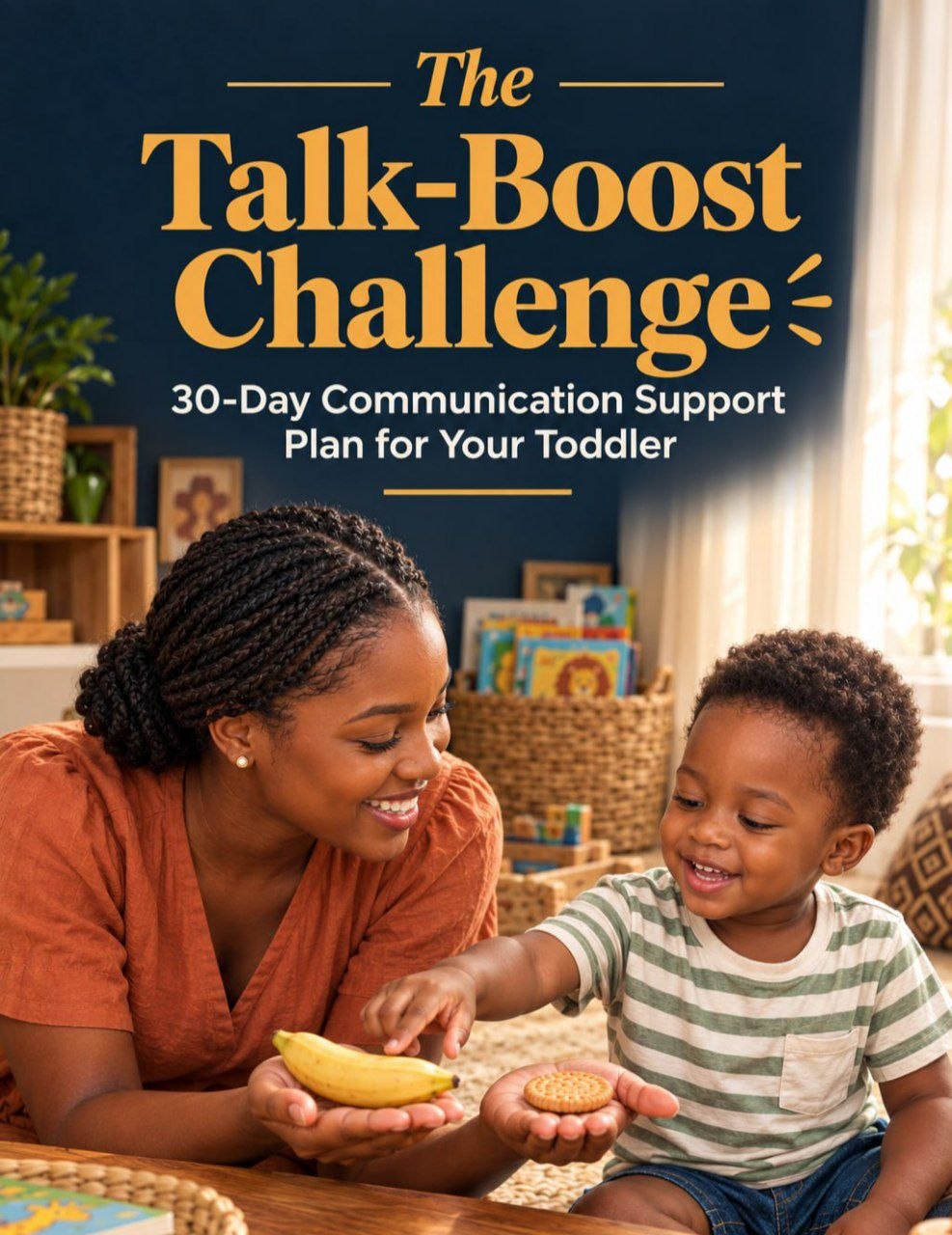
Your actual Talk-Boost materials on day one.
Launch price: ₦9,800 · Regular price: ₦18,000 · First 50 public purchases only
Created by a Nigerian parent and early childhood researcher who understands what it's like to search for practical communication strategies that actually fit real family life.
You've seen what the plan looks like. But the harder part may be everything that led you here.
Maybe you've been here before. Your toddler points at something instead of saying the word.
"Don't worry. Some children just talk late."
"You need to take the child for therapy."
So you start searching: Google, Instagram, YouTube, WhatsApp groups, parenting pages. One person tells you to talk more. Another tells you to stop doing something. Someone sends an exercise. Someone else gives a completely different opinion.
And after saving dozens of tips… you still don't know what to actually do with your child today.
That's not because you don't care. It's because you care so much you're trying to find the right thing to do, and when all you have is a pile of disconnected tips, it's hard to know what to do first, how often, and what comes next.
That's where having a plan changes things.
Tips Aren't Usually the Problem. A Plan Is.
You've probably already collected plenty of tips. The missing piece is knowing what to do with them, when to do it, and what to do next. Talk-Boost turns everyday interaction into more intentional opportunities for communication: eating, bathing, getting dressed, playing with toys, looking at books, singing songs, simple games, family routines, taking turns, and following your child's interests.
The goal isn't to turn your home into a therapy clinic. It's to become more intentional about the communication opportunities already present in your child's day.
Instead of asking yourself every morning "what should I try today?", you open the plan and know where to begin. Here's exactly how that plan is built.
The Talk-Boost method
Talk-Boost takes that shift and turns it into a structured 30-day sequence. You are not deciding what to try each morning. You are opening the plan and following the next step.
Four weeks. One clear progression.
Why the order matters
Random tips can give you something to try. A sequence gives you a starting point, a next step, and a way to repeat the practice instead of starting over each day.
You can't expand on a child's communication attempts (Week 3) until you're first creating room for them to happen (Week 1) and modelling language around them (Week 2). Play-based practice (Week 4) works best once responding, narrating, and expanding have already become habits, not new skills you're trying to remember mid-activity. The point isn't that any one activity guarantees an outcome; it's that you're no longer inventing your approach from scratch every day.
By the end of the 30 days, you won't have another folder of random activities. You'll have worked through a structured sequence that helps you become more intentional about communication in everyday life.
Here's what that sequence looked like for one mother who followed it from Day 1.
"Your guide gave me a plan."
A message from Amara after using the guide.
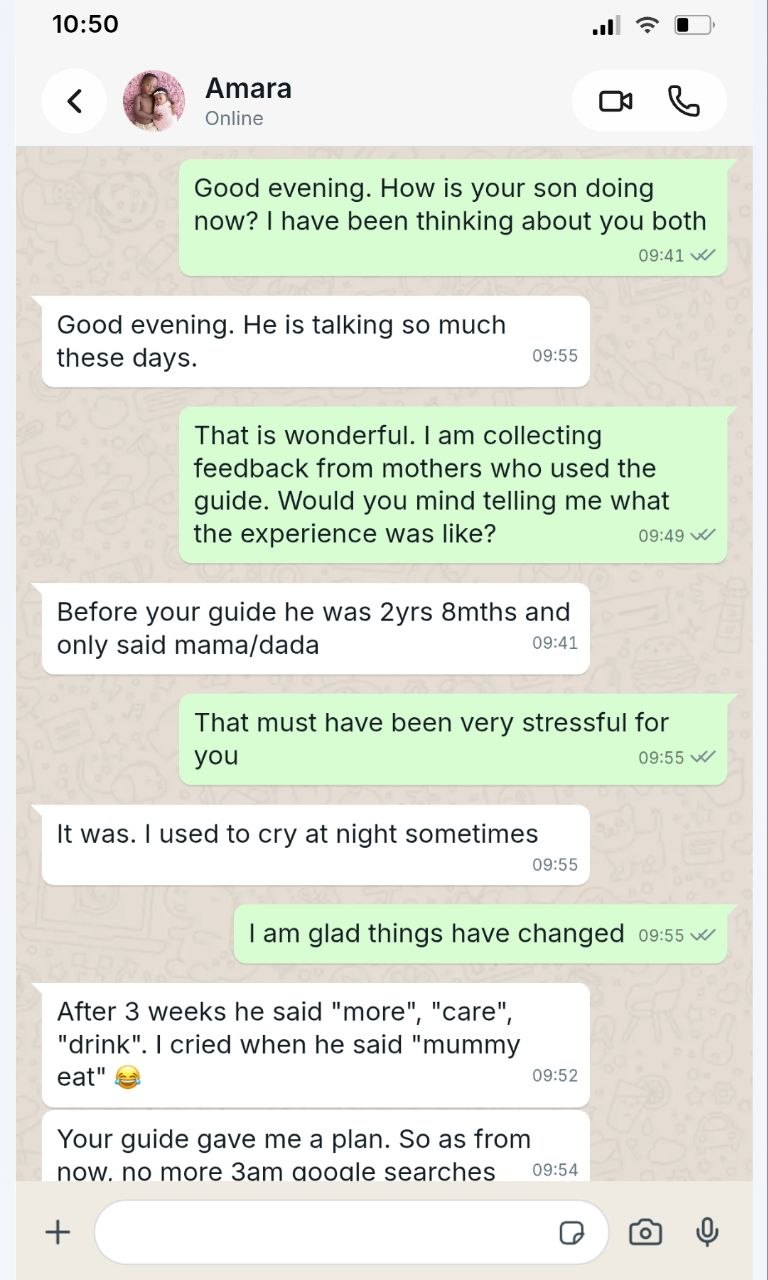
Individual experience. Results vary from child to child.
Amara's story is one 30-day journey. Here's the core of what made it possible: the Protocol itself, page by page.
Here's what the 30-Day Protocol actually looks like
This is not a document you download, glance at once, and forget. It is built to be opened, followed, and used day by day: and it's just one piece of what you'll get.
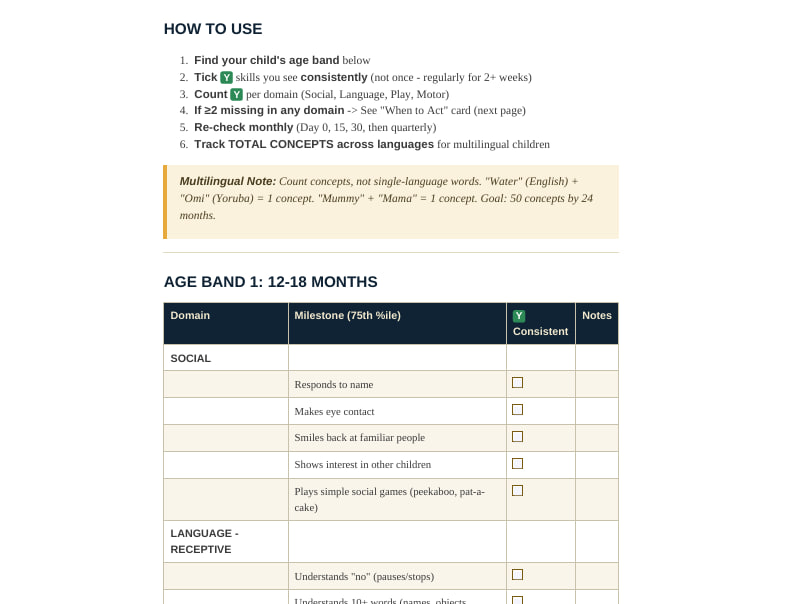
Milestone Check
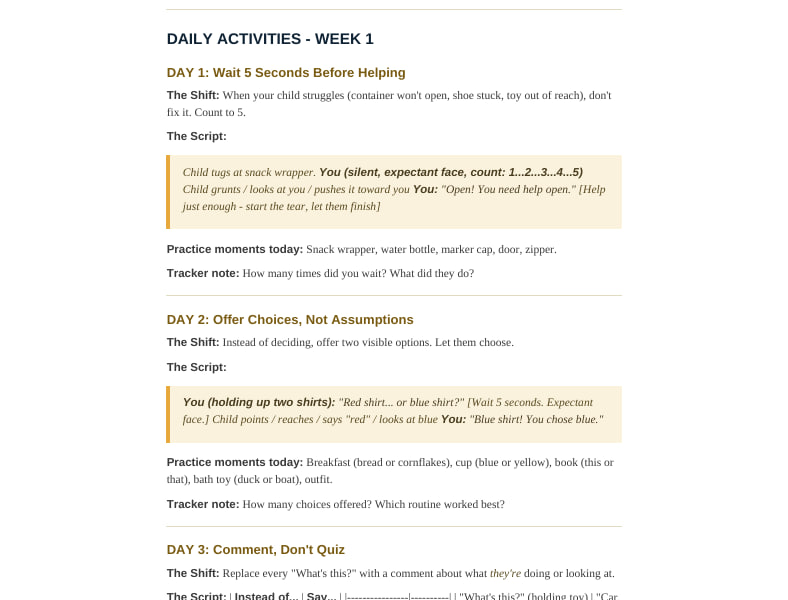
Day 1: Week 1
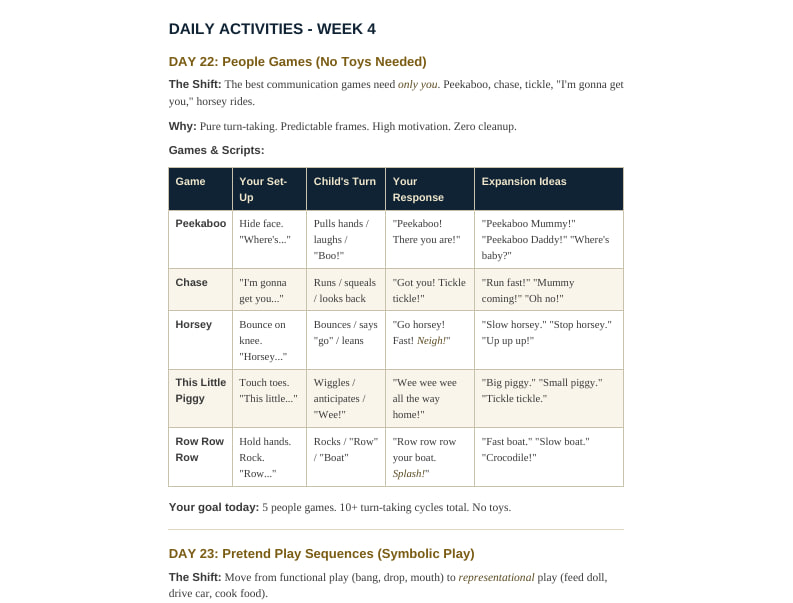
Day 22: Week 4
What one of those days looks like in practice
Snack-Time Choices
Instead of automatically handing your toddler their snack, put two options in front of them.
Then wait. Give your child room to respond: a word, sound, gesture, point, reach, look, or another attempt to communicate. Respond to the attempt.
That's the philosophy behind Talk-Boost: less pressure, more purposeful interaction.
That's one day, from one piece of the system. Here's everything else that comes with it.
One system. Six pieces. Each solving a different problem.
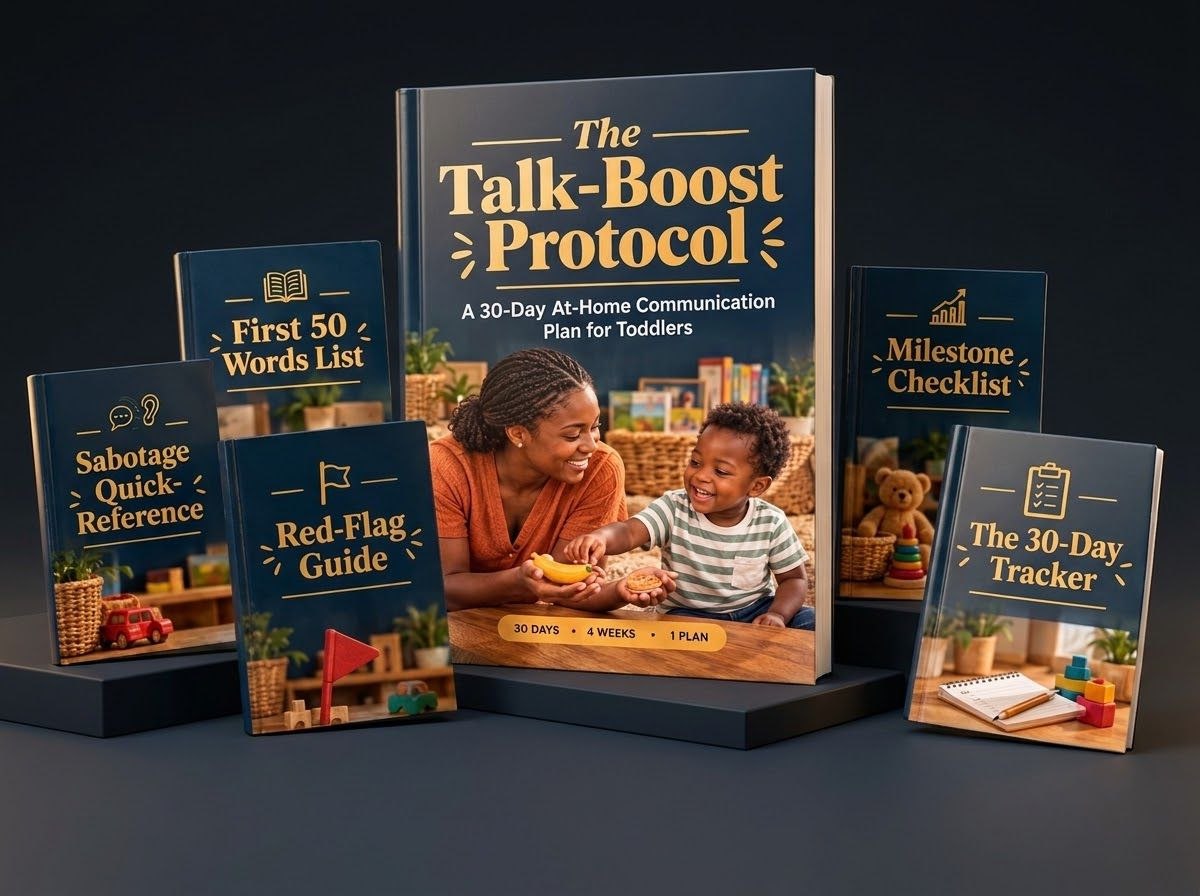
The 30-Day Talk-Boost Protocol
Solves: "What do I do, and when?" Your main roadmap: Milestone Check, Environment Setup, all four weekly modules, daily activities, and everyday-routine applications.
The 30-Day Tracker
Solves: "Did I actually do it?" A standalone daily checklist. Check it off and keep moving. Use it on your phone or print it.
The Sabotage Quick-Reference
Solves: "What do I say right now?" 10 everyday scenarios and exactly what to do when your toddler points, reaches, or waits for you to guess what they want.
The Milestone Checklist (Ages 1–4)
Solves: "Is this normal?" A simple reference for what to expect at each age, so you're not guessing or comparing against the wrong benchmark.
The First 50 Words List
Solves: "What should I model first?" The most useful early words to focus on, with examples of working them into meals, bath time, and play.
The Red-Flag / When to See a Professional Guide
Solves: "When do I need more help?" A standalone reference for knowing when to pause and seek professional attention, so you're not left wondering.
First 50 public purchases only
Build communication practice into the life you already live
You don't need a special therapy room, expensive equipment, or hours of uninterrupted time. Talk-Boost is built around ordinary moments already happening in your home: mealtimes, bath time, play, books and songs, siblings, and family routines.
Funke was already working with a speech therapist when she started. Here's what daily practice at home added.
"Your daily routines kept everything going at home."
A message from Funke after using the guide.
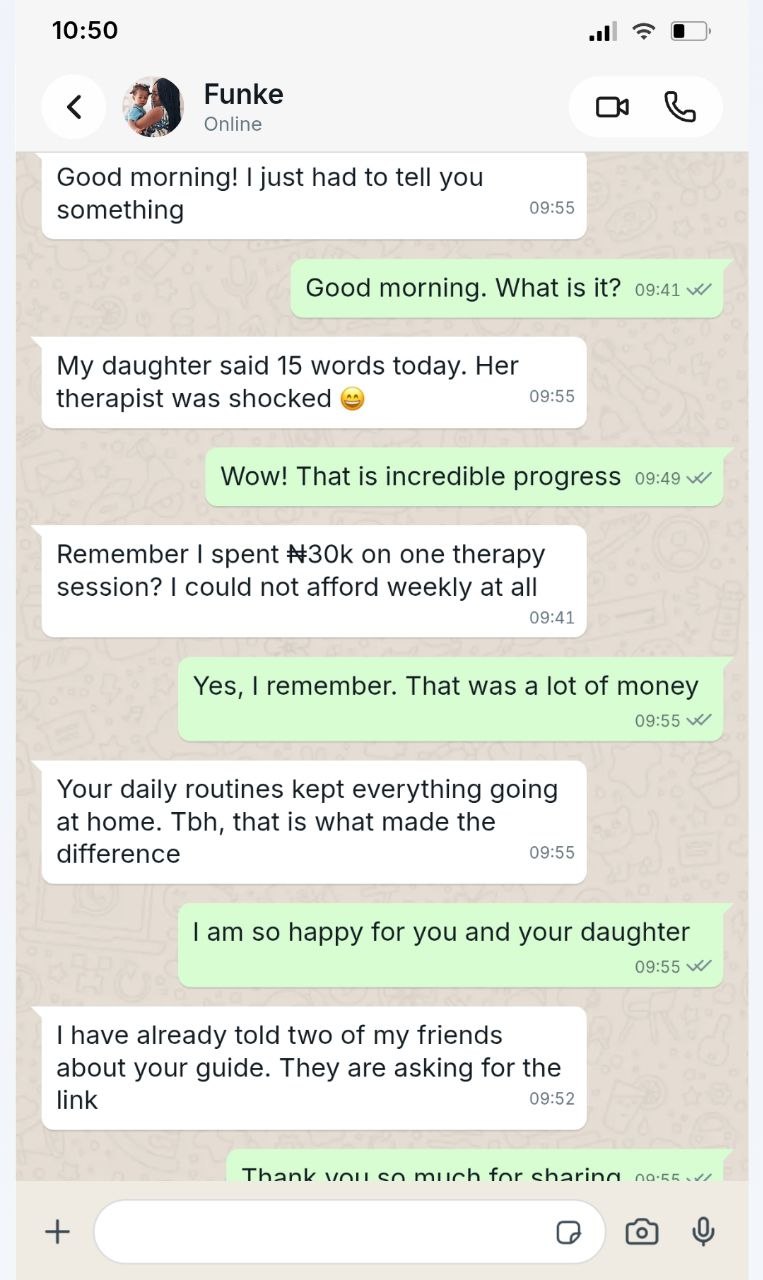
Context: Funke says her daughter was already seeing a speech therapist, but weekly sessions were difficult to afford.
What she reported: Her daughter said 15 words in one day, and her therapist was shocked. She credited the daily home routines with keeping practice going between sessions.
Individual experience. Results vary from child to child.
That flexibility extends to language too.
What if we speak more than one language?
Many Nigerian families naturally move between languages: English, Yoruba, Igbo, Hausa, Pidgin, or a combination used by different family members.
Talk-Boost focuses on responsive interaction and meaningful communication, not forcing your family into an artificial language routine. Use whatever language or languages naturally make sense for your family. The important thing is creating opportunities for your child to listen, participate, respond, and communicate with the people around them.
With all of that said, you might still be wondering something.
"But can't I just find this information online?"
Yes. You probably can. Individual tips on Google, Instagram, YouTube, Facebook, WhatsApp groups, parenting blogs, videos, saved posts.
That's exactly why Talk-Boost isn't built around the idea that information is impossible to find. The value is in what happens after you find it. Instead of collecting another 20 tips, Talk-Boost gives you a sequence, a daily direction, and the full set of quick-reference tools (tracker, word list, milestone checklist, quick-reference scenarios, and a resource for knowing when professional attention may be appropriate).
You don't have to keep asking, "Which tip should I try?" You have a plan, and you know where to begin.
For some parents, the biggest shift isn't just the words. It's how it feels to finally have an answer.
"Now I am the one smiling."
A message from Ngozi after using the guide.
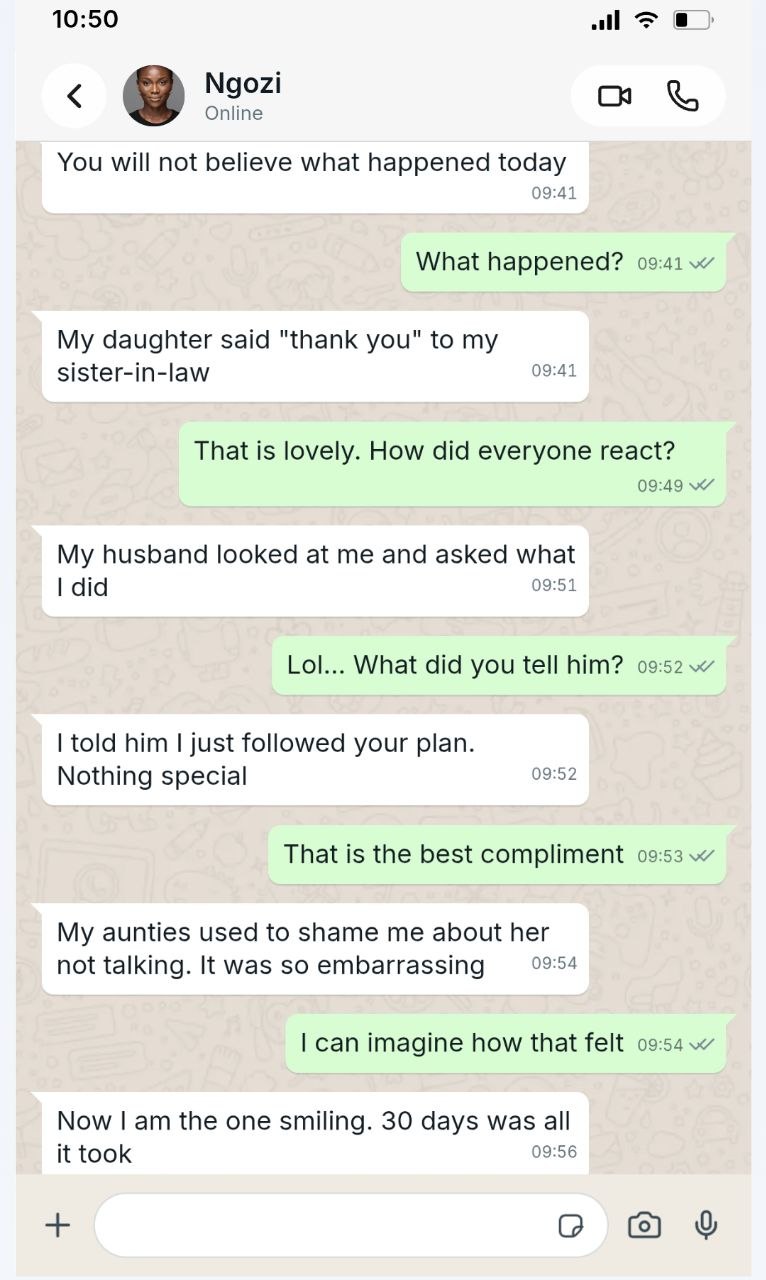
What Ngozi reported: Her daughter said "thank you" to her sister-in-law, and Ngozi told her husband she had followed the plan.
The emotional shift: She described moving from being shamed by relatives about her daughter not talking, to feeling like "the one smiling."
Individual experience. Results vary from child to child.
Get the Talk-Boost Challenge: ₦9,800First 50 public purchases only
Amara, Funke and Ngozi are three individual stories. So before you decide if this is for you, here's the honest picture.
What Talk-Boost is, and who it's for
- You're concerned about your toddler's communication development
- You want practical things you can do at home
- You've become overwhelmed by conflicting advice
- You want a structured routine rather than random tips
- You want activities that fit into normal family life
- You want a guide that doesn't leave you guessing about when professional help may be appropriate
- A diagnostic tool
- A substitute for professional assessment
- A cure for a developmental condition
- A guarantee that your child will speak within 30 days
- A replacement for speech-language therapy when that's needed
Talk-Boost is a parent-coaching and communication-activity guide designed to help you support communication through everyday interaction, play, and routines. It is a practical place to start, not a replacement for professional care.
That should cover the big picture. Here are the specific questions parents usually ask next.
Frequently asked questions
Will my child definitely start talking within 30 days?
Every child is different, so no specific speech outcome can be guaranteed within 30 days. The 30-day structure gives you a consistent plan for supporting communication opportunities at home.
Is this speech therapy?
No. Talk-Boost is a parent-led activity and coaching guide. It does not replace professional assessment or therapy.
What if my child already sees a therapist?
Talk-Boost is designed around everyday parent-child interaction and can provide additional structure for what you do at home. Your child's therapist remains the right person to advise on their individual clinical needs.
What if we speak more than one language at home?
You can apply the approach within whatever language(s) your family naturally uses. The focus is responsive interaction, not a language rule.
What if I find something concerning in the Red-Flag Guide?
The guide helps you recognize when professional attention may be appropriate. If something raises concern, seek appropriate professional guidance rather than assuming everything should be handled at home.
Why pay for something I can find online?
Because the value isn't the existence of individual tips. It's the structured 30-day sequence, daily direction, and the full set of quick-reference tools (tracker, word list, milestone checklist, and more) that mean you spend less time searching and more time practicing.
Are these testimonials genuine?
Yes. The messages and screenshots are from parents who had access to the Talk-Boost approach before its wider public launch, and they gave permission for their conversations to be shared. Their experiences are individual and are not a guarantee of the same result for every child.
You've seen the plan, the proof, and the honest answers. Now here's exactly what you get when you start.
Stop collecting tips. Start following a plan.
The Talk-Boost System
The 30-Day Talk-Boost Protocol: Your 30-day roadmap for what to do, when to do it, and what comes next
The 30-Day Tracker: A simple way to follow through on each day's activity
The Sabotage Quick-Reference: 10 everyday scenarios and exactly what to say in the moment
The Milestone Checklist (Ages 1–4): What to expect at each age, so you're not guessing
The First 50 Words List: The most useful early words to model, with examples
The Red-Flag / When to See a Professional Guide: A clear reference for knowing when professional attention may be appropriate
Six pieces, each solving a different problem: what to do, whether you're doing it, what to say in the moment, what's normal, what to model, and when to get more help. One system, not six separate things to keep track of.
₦35,500 is what these six resources would cost bought individually. As a bundle, The Talk-Boost Challenge is being introduced to the public at ₦9,800 for the first 50 purchases; after that, the bundle's regular price becomes ₦18,000.
Get the Talk-Boost Challenge: ₦9,800First 50 public purchases only
One last thing, before you decide.
You've already searched. Asked questions. Heard different opinions. Maybe you've even saved things you meant to try.
But the real question isn't, "Can I find another tip?" It's, "Can I finally have a clear plan for what I can do today?"
That's what Talk-Boost gives you: a structured 30-day path, a way to follow through, quick answers for the moment, a sense of what's normal, what to model, and a clear line for when to get more help.
You don't need to become an expert overnight. You don't need to figure everything out tonight. You can simply start with Day 1.
Get the Talk-Boost Challenge: ₦9,800Regular price: ₦18,000 · First 50 public purchases only
Start with a plan. Take it one day at a time.