A Retired Nigerian Paediatric Nurse Reveals a 21-Day Bedtime System That Helps Mothers Stop Their Child's Bedwetting Without Clinics or Confusion

You wake up before your alarm.
Not because you slept well. You didn't. You woke up twice in the night to check on him — lifting the edge of the blanket quietly, pressing your palm against the sheet, holding your breath.
And now it is 5:47am. And the sheet is wet again.
Another morning. Another load of washing. Another wave of that heavy, sinking feeling you cannot explain to anyone.
You strip the bed fast — before the house wakes up. Before your husband rolls over. Before the other children come running in. You know this routine so well you could do it with your eyes closed. Wet sheet off. Rubber protector wiped down. Fresh sheet on. Window cracked open so the smell goes before morning prayers.
By 6am, it is like it never happened.
Except that it did. And it has been happening — almost every single night — for the past three, four, maybe five years.
He's nine years old now. Nine. When is this supposed to stop?
You have read that "it's normal." You have been told "he will outgrow it." You have nodded your head in the doctor's office, thanked the nurse, walked out to the car, and cried quietly before turning the key in the ignition. Because "he will outgrow it" does not help you at 2am. It does not wash sheets. It does not explain what to do with the guilt you feel every time you look at your son's face and wonder if you are somehow doing something wrong.
You have tried waking him up at midnight. Every night for three weeks. Setting an alarm. Dragging a half-sleeping child to the toilet, getting him back to bed, falling asleep yourself... only to find the sheet wet by 4am anyway. You stopped. You were too exhausted to continue.
Maybe it's what he's eating. Maybe it's stress from school. Maybe it's spiritual. Maybe it's me.
You have tried the herbs. Your mother-in-law brought a bitter mixture wrapped in a black nylon bag. She said "mix it with warm water, give it to him every morning." You did it for two weeks. The boy's stomach ran. The bedwetting continued. You quietly poured the rest of the mixture down the drain and told her it "seemed to be helping."
You have restricted water after 6pm. Then after 5pm. You have watched your child beg for water at dinner and felt terrible refusing him — then stayed up until midnight making sure he used the toilet before bed — and still woke to a wet mattress. Nothing. Changed.
You have not told your sister-in-law. You have not told your mother-in-law. Because you know exactly what they will say. The side glances. The "hmm, still?" You have moved birthday sleepovers to your house — always your house — so he is never in a position to be embarrassed in front of his cousins. You have perfected the lie: "He just prefers to sleep at home."
You are not a bad mother. You know that. But in these early morning moments, standing in a cold room holding a wet bedsheet, it does not feel that way.
You are tired. Deeply, specifically, exhaustingly tired — not from lack of sleep alone, but from the kind of tired that comes from carrying something alone for too long.
Because I am about to share with you a simple 21-day system that changed everything for me — and for dozens of other Nigerian mothers who were exactly where you are right now.
Before hospitals. Before paediatric clinics. Before the internet told every mother to just "wait it out" — our grandmothers were solving this problem quietly inside their homes.
Not with pills. Not with elaborate machines or expensive consultations. With routine. Timing. Intentional daily structure. Passed from one mother to the next, generation to generation, with no fanfare and no marketing.
Most of us lost access to that knowledge somewhere between modernity and migration. We replaced our grandmothers' wisdom with Google searches and clinic waiting rooms — and received very little in return. This method has been around for decades. It was just never written down. Until now.
My name is Ngozi Amaka.
First thing you should know about me: I am not a doctor. I hold no current medical licence. I am not a parenting coach or a specialist of any kind. I am a retired paediatric nurse — 21 years in Lagos government hospitals and private clinics — who got angry enough about what she kept seeing to do something about it. I am a mother. I am a grandmother. And for a season, I was the same exhausted woman you are right now, standing in the dark holding a wet sheet, wondering what I was missing.

My son Emeka was five years old the first time it happened.
I didn't panic. All children wet the bed. I was a paediatric nurse — I knew the statistics. I knew the developmental charts. I told myself: he will be fine.
He was seven the first time I cried about it privately. In the bathroom. With the tap running.
Not because I was ashamed of him. Never that. But because I had run out of answers — and I was supposed to be someone who had answers. I had spent two decades telling other mothers "this is manageable, here is what to try." And now, in my own home, with my own child, I had nothing.
My husband Chukwudi was patient at first. He never made it a big issue. But I noticed the small things — the way he started making up the guest room when his relatives were visiting. The way he'd go quiet when Emeka came to the breakfast table looking sheepish. He wasn't angry. He was just... waiting. Hoping the next week would be different. And so was I.
The emotional weight of it sat on our marriage in a way I couldn't name. Not arguments. Not blame. Just this low, quiet tension of a problem neither of us knew how to solve.
The breaking point came on a Thursday morning in November.
Emeka's teacher had called me — not about his schoolwork, which was fine — but to tell me, gently, that some of the children had noticed a smell on him in the mornings. That he seemed withdrawn. That she was "just letting me know."
I thanked her. I drove home. I sat in the parked car outside our gate for 45 minutes before I could make myself walk inside.
He was eight years old. He was becoming aware. He was starting to hide it — from me, from himself. And the shame of it was beginning to change him.
That evening, my older sister Adaeze called to check in. I told her everything. I hadn't told anyone until that moment. And she said something I haven't forgotten:
"Ngozi, you have been treating this like a medical problem that needs a diagnosis. But some things don't need a diagnosis. They need a system. A structure. The body responds to structure. That is what nobody is telling you."
I was irritated when she said it. I wanted science. I wanted a prescription. I didn't want folk wisdom from my older sister who had never trained in a hospital a day in her life. But something stuck.
In the months that followed, I tried everything with the rigour of someone who had spent two decades in healthcare.
I tried the midnight waking schedule — setting an alarm at 12:30am, getting up every single night to take Emeka to the toilet. It worked for about a week. My body revolted. I started making errors at work during my last months before retirement. My husband took over for two nights and then couldn't sustain it either. We stopped. The bedwetting continued as if we'd never tried.
I tried strict fluid restriction after 5pm. No water, no juice, no soup after dinner. My son was thirsty. He was miserable. He started sneaking water from the bathroom tap in the middle of the night — I found this out by accident. And still: wet sheets by morning. The restriction was doing nothing.
I tried herbal mixtures from two different relatives. The first caused Emeka to have stomach pain for three days. The second tasted so foul he gagged every morning. After four weeks, no change.
I tried the spiritual route — and I am a person of deep faith, so I say this carefully. We prayed. We anointed. We fasted. And I believe in the power of prayer with my whole heart. But I also believe God gives wisdom to those who ask, and I had not yet found the wisdom. The physical pattern did not change through prayer alone.
I visited three different paediatric clinics. At each one, after a consultation, I received essentially the same answer: "This is primary nocturnal enuresis. It is extremely common. In most cases, children outgrow it by adolescence. Come back if there are other symptoms." One doctor gave me a pamphlet. The pamphlet said to restrict fluids at night and wake the child periodically. Things I had already tried. Things that hadn't worked.
I read every parenting blog and online forum I could find. Most articles said the same things in different arrangements. None of them gave me a structured, sequential plan that told me exactly what to do on Day 1, Day 5, Day 14. They were full of suggestions. None of it was a system.
I was losing hope.
In March of that year, I attended a family wedding in Ibadan — my cousin Obinna's second marriage. Big Yoruba-Igbo affair, the compound was packed.
Sometime around 3pm, I slipped away from the noise to get some air behind the main house. That is where I found her.
Mama Florence.
She was seated in a plastic chair in the shade, fanning herself with a folded programme, looking absolutely unbothered by the chaos around her. Seventy-two years old. Retired traditional birth attendant. Community health matriarch who had delivered half the babies in that part of Ibadan for thirty years. I had known her since I was a child. She always smelled of camphor and shea butter, and when she spoke, every word felt weighed before it was released.
I sat beside her. She looked at me the way old women look at you when they already know something is wrong. "You look tired," she said. Not unkindly. Just straight.
I told her about Emeka. Everything — the clinics, the herbs, the midnight waking, the teacher's phone call. She listened without interrupting, which is rarer than it sounds. Then she was quiet for a long time, watching the children running across the compound. Finally she said:
"Before these clinics, we did not tell mothers to wake up at night. That is exhaustion. That is not a solution — that is suffering disguised as effort. What we did was train the body during the day. You cannot fix a night problem at night. You fix it in the morning. In the afternoon. At dinnertime. By the time the child sleeps, the work is already done. You are trying to put out a fire at midnight. We start in the morning."
I stared at her. "During the day? But the problem happens at night."
She smiled. Patient. Like she had answered this question before. "The bladder learns in the day what to do at night. Give it enough work during daylight, the right fluids at the right times, train it with small exercises — stop and start, hold a little longer each time — and by the time that child sleeps, the bladder already knows. It is not magic. It is just... teaching."
She went on. She told me about the double-void — making the child urinate, wait five minutes, then try again before bed. She told me about food timing — how certain things eaten after a certain hour put extra pressure on a child's bladder in ways parents never connect. She told me about the importance of how a parent responds in the morning after a wet night — that shame and frustration rewire a child's anxiety around sleep, which makes the problem worse, not better.
I sat in that compound for two hours with Mama Florence. By the time the evening jollof was served, I had written four pages of notes on the back of the wedding programme.
I will be honest with you: I did not fully believe it at first. Not because I doubted Mama Florence. But because it sounded too simple. Too ordinary. I had been through clinics and specialists and I was sitting in a wedding compound being told the answer was daily bladder training exercises and fluid timing. But I had nothing left to try. So I started.
Day 1. Day 2. Day 3. Wet mornings, all three. I kept going.
Day 4: wet. I almost stopped. This is not going to work. This is too simple to work. Nothing this simple works.
Day 5 — I remember this morning with startling clarity. I woke up and lay still for a moment before I moved. A habit by then. Bracing before I looked. Then I reached my hand slowly to the sheet. And it was... dry.
I pressed it again. Lifted the corner. Dry. Completely dry. I actually smelled it — yes, I smelled the sheet — because I could not believe what I was feeling. Dry.
I sat up slowly. Emeka was still asleep. And I sat there on the edge of that bed and pressed my face into the dry sheet and cried. Not loudly. Silently. Just shaking a little. Nine years of motherhood. This one dry morning.
By Day 9, we had three dry nights in a row. By Day 14, five out of seven nights were dry. By Day 21 — the morning I still think about when things feel impossible — Emeka came to breakfast and said quietly, "Mummy, I think it's stopping."
That evening, Chukwudi was putting the kids to bed. He came back into the kitchen and looked at me — just looked at me for a long moment — and said: "Wait. So he didn't wet the bed again?"
I said: "Eight nights now."
He sat down at the kitchen table. Like the information needed a moment to land. Then: "Eight nights? Eight in a row?"
After that, I noticed him checking the bedsheets himself on mornings I hadn't mentioned anything. Not making a big thing of it. Just quietly pressing his hand to the sheet, the way I used to do, and walking out of the room with this small, private expression on his face that I can only describe as relief.
At the wedding that day in Ibadan, Mama Florence had not spoken only to me. There were three other mothers seated nearby who had drifted into our conversation. All of us left with the same notes.
About six weeks later, I called Mrs. Olamide Adeyemi — she had two boys, 7 and 10, both wetting the bed. She told me her older boy had stopped completely by Day 18. "Ngozi," she said, "my husband thought I had taken the boy to some kind of healer. He could not believe it."
Dr. Blessing Nwosu had a daughter, age 8. She messaged me at 6am one morning: "Day 14. Dry again. I want to cry every morning." I understood exactly what she meant. Every dry morning feels like a small miracle until it becomes a normal morning, which is an even better miracle.
And there was Auntie Remi — who reported back within the month: two dry weeks. She was so relieved she sent me a tray of puff-puff via her driver.
It was working. It was not magic. It was a system. And I knew I could not keep giving this out one conversation at a time.
Introducing
Dry By Morning: The 21-Day Nigerian Mother's Protocol for Ending Bedwetting
After Ibadan, I had four pages of handwritten notes. After Emeka's results, I had three months of personal documentation. After hearing from Olamide, Blessing, and Auntie Remi — I had proof that this was not a one-child coincidence.
But I kept getting messages. Calls. Women finding my number from women who found my number from women I had never met. All asking the same thing: Can you send me that routine?
I cannot personally guide every mother through twenty-one days of a protocol. So I did the only sensible thing I could. I put everything inside a single, easy-to-follow guide. The full bladder training routine. The Nigerian fluid timing system. The pre-sleep double-void ritual. The exact parent response script for wet mornings. The list of foods that are directly making the problem worse. The 21-day tracking sheets. The 30-day maintenance plan so the results hold. All of it. In one guide.
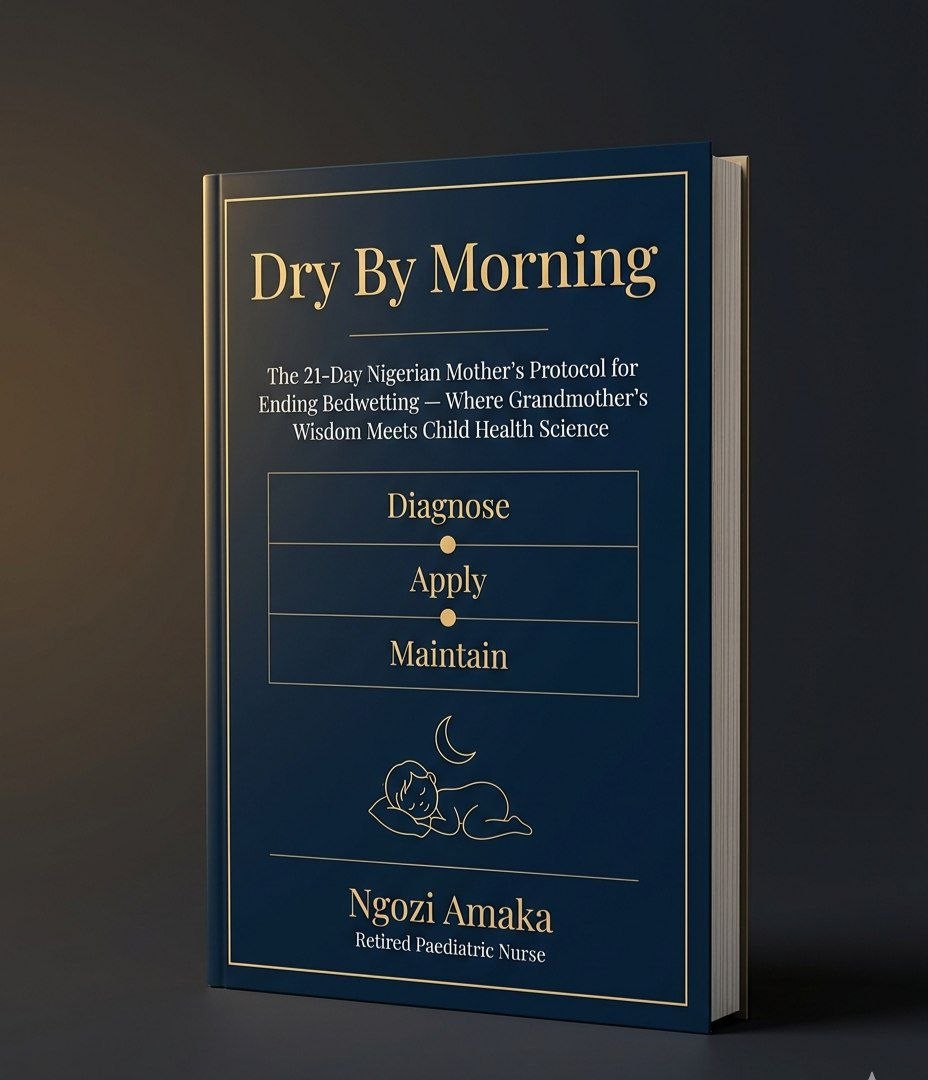
Inside this e-guide, you will discover:
- Bladder Reconditioning Routine — Pg. 5
The step-by-step daytime training exercises that teach your child's bladder to hold more and signal earlier. This is the foundation everything else builds on — and it takes less than 10 minutes a day. - The Nigerian Fluid Timing System — Pg. 8
Why restricting water after 6pm has never worked — and the exact morning-heavy hydration schedule that actually retrains the bladder from the inside out, using the way Nigerian families already eat and drink. - Pre-Sleep Double Void Ritual — Pg. 11
The specific two-step bedtime toilet routine that dramatically reduces the amount of urine the bladder needs to hold overnight. Most parents have never heard of this. It takes four minutes. It changes everything. - The No-Shame Parent Response Script — Pg. 14
Exact words and phrases to use with your child the morning after a wet night — and what you must never say again. Shame and anxious parenting responses are silently prolonging the problem. This section shows you how to break that cycle. - Foods That Trigger Night Wetting (Nigerian Edition) — Pg. 17
A specific list of common Nigerian foods and drinks — things you are likely eating every day — that directly irritate the bladder and worsen bedwetting. Some of these will surprise you completely. - The 21-Day Tracking System — Pg. 20
A simple daily checklist so you know exactly what to do each morning, afternoon, and evening. No guessing. No wondering if you're doing it right. Just follow the day, check the box, watch the results build. - 30-Day Maintenance Plan — Pg. 24
What to do in the month after the 21 days are complete to lock in the results and prevent regression. This is what makes the difference between a temporary improvement and a permanent one.
Real Women. Real Testimonials.
Verified responses from mothers who used the Dry By Morning Protocol
My son don dey dry for 2 weeks now. TWO WEEKS. This pikin wey dem talk say will just "outgrow am." I cried the morning I touched that dry sheet. I literally cried. Ngozi, God will continue to bless you. The food timing page alone changed everything for us — I had no idea eba at night was part of the problem.
I was skeptical when my friend sent me this. Ghana woman, Nigerian guide — I thought it won't apply to us. But the principles are the same, the foods listed — our foods — it was all relevant. My daughter (8 years old, been wetting since she was 5) had her first completely dry week on Day 17. I have been recommending this to every mother I know.
We are in London but our diet at home is fully Nigerian, so every part of this guide applied to us. My son is 10. His paediatrician here told us to "monitor it" and come back in six months. Six months! This guide gave me a 21-day plan with actual daily steps. By Week 3, my son came to me one morning and said "Mum, I think I'm better." I had to go to the bathroom so he wouldn't see me cry.
The No-Shame parent response script on page 14 — this alone was worth everything. I didn't know that the way I was reacting in the mornings was making it worse. Once I changed my morning response, something shifted in him. He relaxed. And then the dry nights started coming. Honestly this is not just a bedwetting guide — it is a parenting guide.
Wallahi I tried everything before this — even took my boy to three different hospitals. All of them said the same thing. "He will outgrow." My son is 9. Then I found Ngozi's guide. Day 7 was his first dry night. By Day 21, we were on a 12-day dry streak. My husband said "what did you give him?" I just showed him the guide. Alhamdulillah.
Just So You Know... Putting This Guide Together in an Easy-To-Read Format Cost Me Over ₦120,000.
I want to be transparent with you, because I believe you deserve to understand what you are getting. This was not a quick Google Doc typed out in a weekend. Here is what actually went into it:
- Professional editor — to make sure every word is clear, structured, and actually easy to follow for a busy mother
- 21-day testing period with real families who gave their time and detailed feedback so I could refine every step
- Graphic designer for the 21-day tracking charts, the printable sheets, and the book design itself
- Research and documentation — cross-referencing traditional knowledge with current paediatric behavioural studies
- Website, platform, and publishing costs — so that you can download this instantly, from anywhere in the world, at any hour of the day or night
I am not going to charge you ₦120,000 — the cost I invested to build this.
I am not going to charge you ₦60,000. Not ₦30,000. Not even ₦19,800 — even though that would be a fair price for what is inside.
Because I remember what it felt like to be exactly where you are. And I remember that when you are that tired, even a small financial barrier is one more thing standing between you and a solution. I do not want to be that barrier.
Secure checkout · Pay by card, bank transfer, or USSD · Instant download after payment
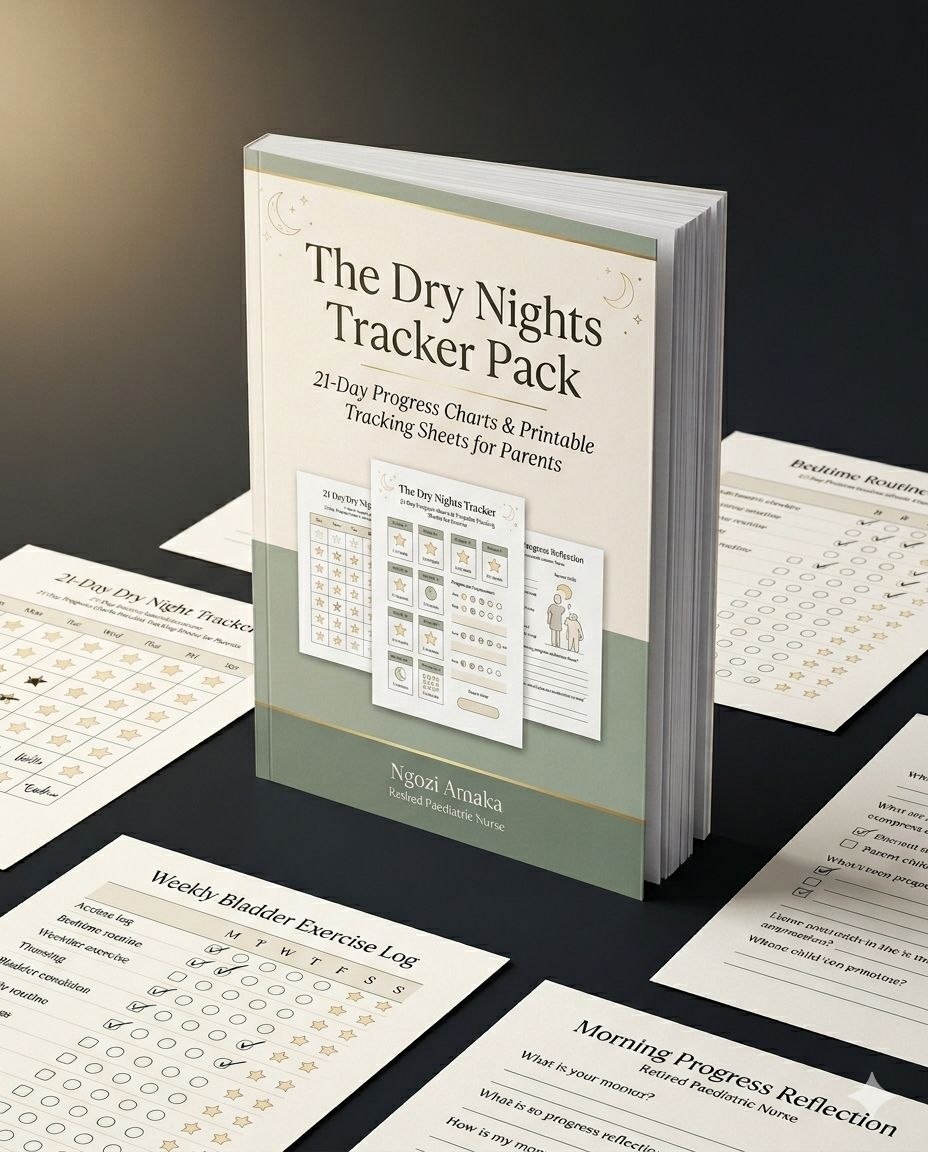
🎁 BONUS 1: The Dry Nights Tracker Pack
Printable 21-day progress charts designed specifically for the Dry By Morning Protocol. Track your child's progress night by night, day by day — so you can see the pattern building and stay motivated through the process.
Parents who track consistently see results faster. This pack makes tracking simple enough to do in 30 seconds every morning.
Value: ₦3,500 — yours FREE with today's order
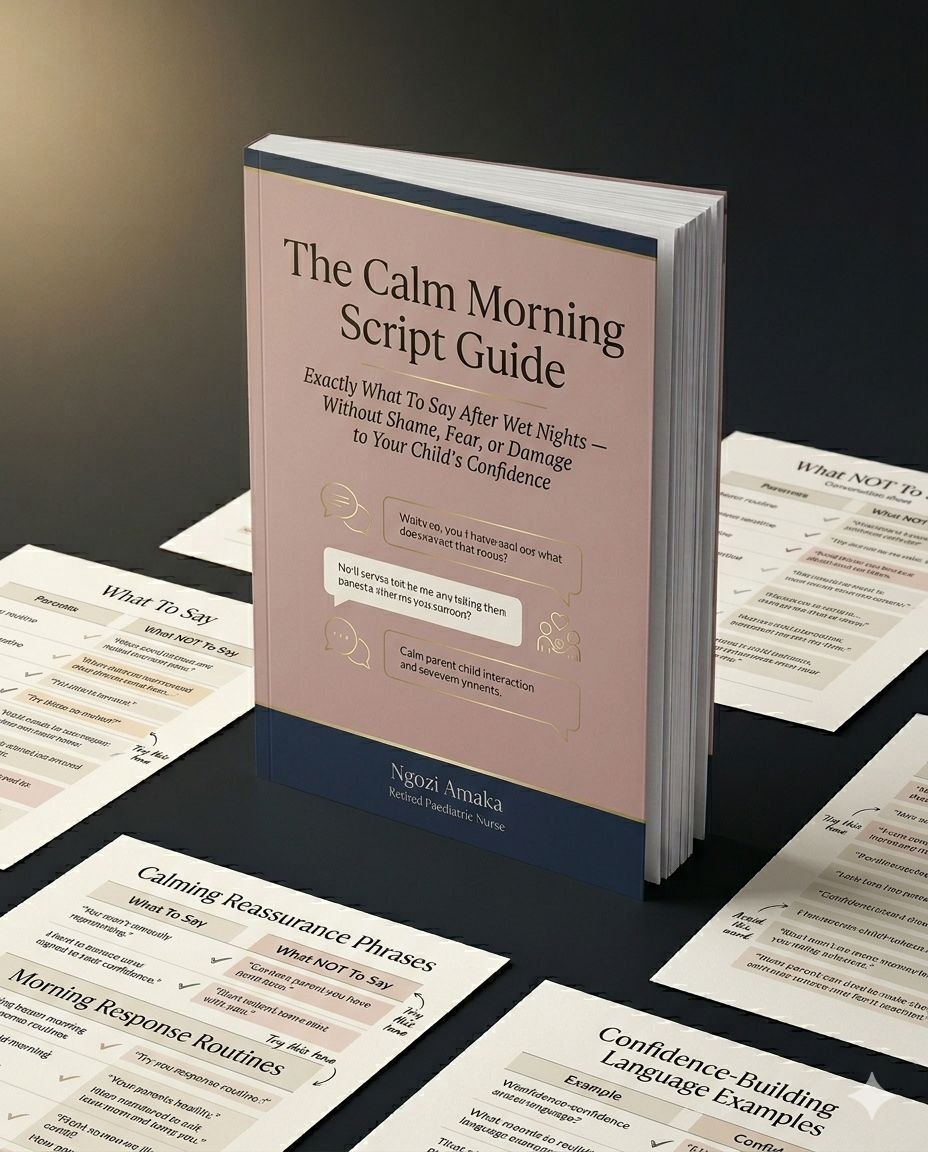
🎁 BONUS 2: The Calm Morning Script Guide
Exact words and phrases to say to your child after a wet night — and the specific things you must never say, even gently. This script is designed to protect your child's confidence while the protocol works.
What you say in the morning matters more than you know. This guide takes the guessing out of it completely.
Value: ₦2,500 — yours FREE with today's order
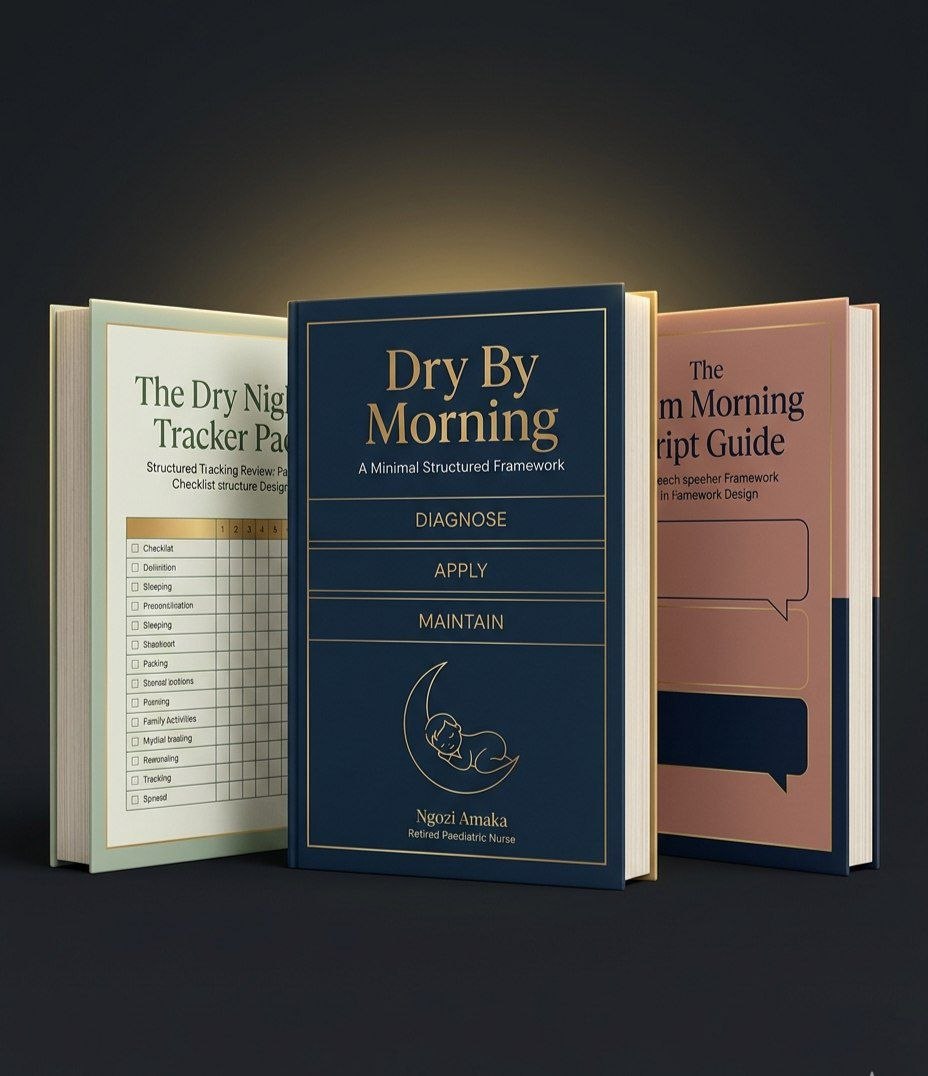
Only for the first 50 mothers · Price returns to ₦19,800 after launch
Other Mothers Are Already Getting In
While you are reading this, other mothers across Nigeria, Ghana, London, and Toronto are making their decision. Here is what the buyer group looked like in the first hours of this launch:
37 out of 50 spots have already been taken in this launch wave at the discounted price of ₦9,800.
That means only 13 spots remain at this price. After the 50th payment, the price returns to ₦19,800 automatically.
Bear in mind — you are not the only mother reading this page right now. Someone else is scrolling down to the buy button at this very moment.
Only 13 spots left at ₦9,800 · All bonuses included · Instant download
My Bold 30-Day Promise to You
Still feeling unsure? I completely understand. You have tried things before that didn't work. You have spent money and emotional energy on solutions that let you down.
Follow the Dry By Morning Protocol for 30 days. If you see no meaningful improvement in your child's bedwetting — not even a single reduction in frequency — send me a message and I will refund every naira of your purchase. No arguments. No forms. No waiting.
I can offer this guarantee with complete confidence because I have seen this system work in real Nigerian homes. Not in a lab. Not in a study. In homes like yours, with children like yours, with mothers who were exactly where you are today. The only way you lose is if you don't try.
More Mothers. More Results.
Every story below is from a real family who followed the protocol
My daughter is 11 years old. Eleven. I was starting to lose hope that this would ever stop before secondary school. We did the 21 days. By Day 19, she had been dry for 10 nights in a row. She told me herself, "Mummy, I think I am healed." I almost fell on the floor. The food trigger list — groundnut soup and malt drink in the evening — I had no idea. Once we adjusted, everything changed.
We are in Canada. The paediatrician here referred us to a specialist. The specialist put us on a 6-month waiting list. SIX MONTHS. I found this guide while looking for something to do in the meantime. My son (age 7) has now had 14 consecutive dry nights. The specialist appointment is still two months away. I honestly might not even need to go.
Subhanallah. This is not just a guide — this is an answer to prayer. My son is 10, and we have been dealing with this since he was 6. My husband was becoming impatient. I did not tell him I bought this — I just started following the steps. By Day 16 he asked me what I had changed. By Day 21 he was the one telling relatives "we have handled it." May Allah reward you abundantly, Ngozi.
My sister-in-law was bringing herbs every month and I was just smiling and using them to avoid conflict. When I found this guide I read it in one sitting at midnight. My boy's first dry night was Day 6. The double-void ritual on page 11 — that page alone did more than four years of herbs and midnight alarms. Simple. Practical. This is real science and real wisdom in one place.
A Nigerian friend sent me this and said "just try it, it applies to us too." She was right. My daughter is 9. The tracker pack bonus helped us stay consistent — it became a little game for her, sticking gold stars on the chart. By the end of Week 3, she had more gold stars than not. That pride — seeing her believe in herself again — was worth ten times the price.
Here is Where You Stand Right Now.
You have two options in front of you. Let me be straight with you about both.
✅ Option One
Take the guide. Follow the 21-day system. Wake up on Day 7 and press your hand to that sheet for the first time with real hope in your chest. Watch the dry nights build. Watch your child's confidence return. Watch your husband's expression when he realises something has actually changed. Reclaim your mornings. Reclaim your peace. Reclaim the part of you that has been quietly exhausted by this problem for years.
❌ Option Two
Close this page. Go back to the midnight wake-ups that burned you out. Go back to the restricted water and the guilty dinners and the morning sheets. Keep smiling when the relatives ask. Keep hiding the secret that is quietly reshaping your child's sense of himself. Maybe he will outgrow it. Maybe next year. Maybe the year after. Maybe God wanted you to find this page today and you decided to leave empty-handed. Who knows?
There are only 13 spots remaining at ₦9,800. After the 50th payment, the price goes to ₦19,800 and the bonuses are removed. This is not a marketing tactic — it is how I structured the launch, and it will not change.
Your child is waiting. Not for a miracle. For a system. For a mother who found the right information at the right time and decided to act on it. That mother is you. Today.
🔒 Secure payment · Instant download · 30-day money-back guarantee
Pay by card, bank transfer, or USSD · Bonuses included automatically
This guide is a digital PDF download. No physical product will be shipped. Results may vary. This guide is for educational purposes and does not replace professional medical advice. If your child has been diagnosed with a specific urological or neurological condition, please consult your paediatrician before beginning this protocol.
Share Your Experience